ESTQ Partners with Sparrow Analytics for Street-Level Air Quality Dat
property air quality data, street level air quality, hyperlocal air quality data, home air quality, property environmental data, air quality by address, Sparrow Analytics, ESTQ, home environmental data, PM2.5 by address
By Adam Fuseman

ESTQ is expanding property intelligence beyond the walls of the home. Through our partnership with Sparrow Analytics, ESTQ users can now access hyperlocal environmental data, including air quality, particulate matter, gases, temperature and humidity, directly within the property experience.
The environmental data is provided by Sparrow Analytics, a Swiss environmental intelligence company building a network of mobile sensors that measure real-world conditions at street level
When people evaluate a home, they usually look at what is inside it.
How old is the HVAC system? When was the roof replaced? Were major renovations permitted? What should a new electrical panel cost? Are there rebates available for an HVAC upgrade?
ESTQ was built to bring this information together around one simple starting point: the address.
But there is another part of the property that matters just as much - what is happening around it.
That is why ESTQ is partnering with Sparrow Analytics.

From Property Data to Environmental Intelligence
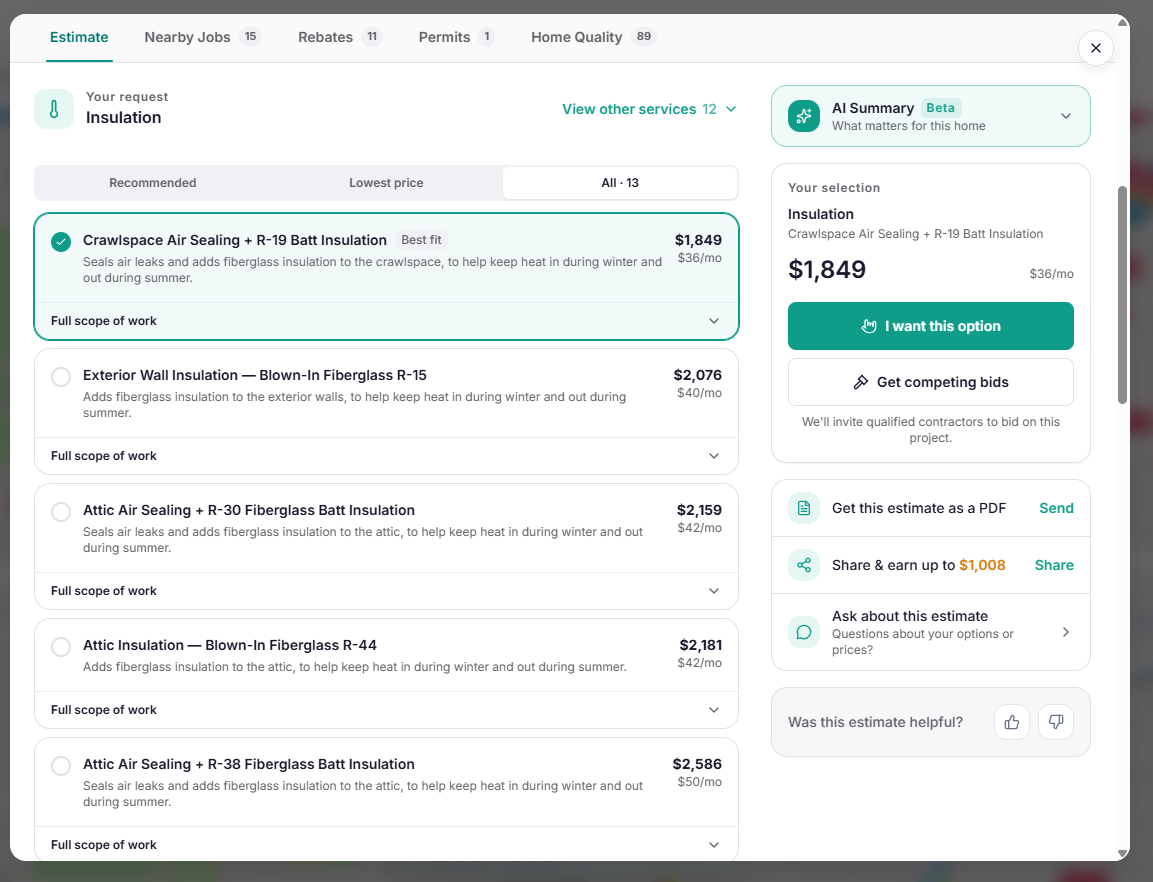
ESTQ already combines property information, permit history, home improvement pricing, estimates, rebates, nearby completed projects and the ESTQ Home Quality Index.
Sparrow adds another layer: measured outdoor environmental conditions around the property.
Instead of relying only on a city-wide average or a monitoring station located miles away, Sparrow collects environmental measurements at street level using sensors mounted on fleet vehicles.
The Sparrow network can measure parameters including PM1, PM2.5, PM10, NO₂, O₃, CO, temperature, humidity and atmospheric pressure. Measurements are collected as vehicles travel through real streets and neighborhoods.
ESTQ can then connect this environmental information with the property itself.
The result is a much more complete view of an address.
What's inside the home + what's happening around the home.
Why Street-Level Air Quality Matters
Air quality is not necessarily uniform across a city - or even across the same neighborhood.
A property close to a freeway, busy intersection, industrial area, construction corridor or heavily traveled road may experience different environmental conditions from another property only a few blocks away.
Traditional air-quality monitoring networks provide valuable regional information, but monitoring stations are relatively sparse. Modeled data can help fill those gaps, but models can also smooth out very local variations.
Sparrow approaches the problem differently.
Its mobile sensor network collects actual measurements as fleet vehicles travel through streets. That means environmental information can be associated much more closely with the places where people actually live and work.
For ESTQ, that fits naturally with how we think about property data.
Averages are useful. Address-level data is better.
What You Can See in ESTQ
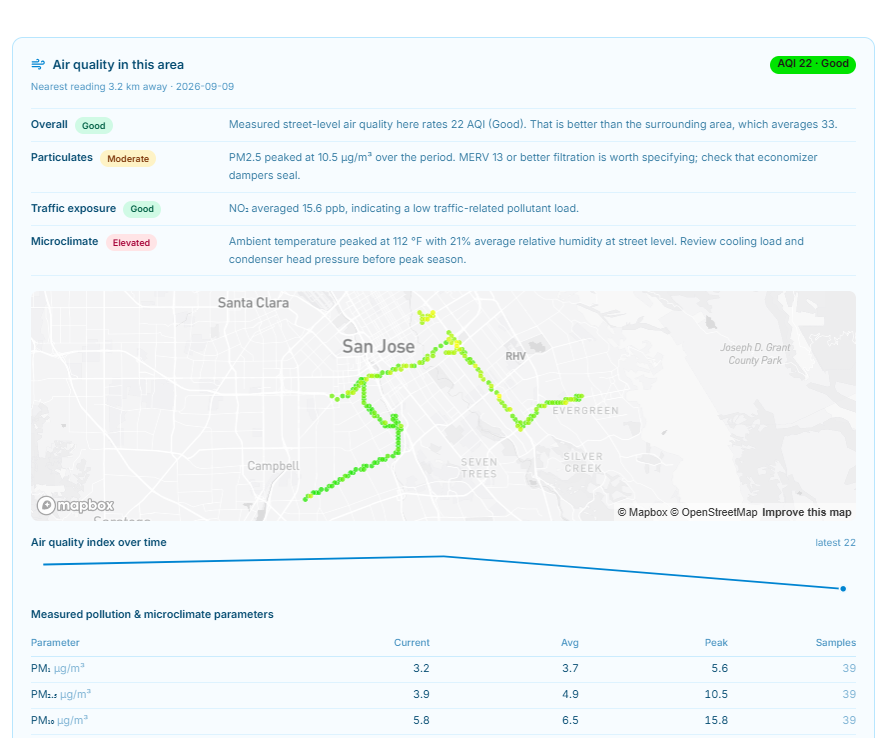
When Sparrow data is available around a property, ESTQ can display environmental measurements directly alongside other information about that address.
Depending on available measurements, users can explore:
PM1, PM2.5 and PM10 particulate matter
Nitrogen dioxide (NO₂)
Ozone (O₃)
Carbon monoxide (CO)
Temperature
Humidity
Atmospheric pressure
Current, average and peak readings
The number of measurements collected around the location
Sparrow Nodes are deployed on fleet vehicles, allowing measurements to be collected repeatedly as vehicles move through an area rather than relying on a single static snapshot.
Example:
https://estq.io/estimate/170-iris-way-palo-alto-california-94303?ref=kuppgJF8
One Address. A Much Bigger Picture.
Imagine evaluating two homes located one mile apart.
On paper, they may look almost identical.
Similar square footage. Similar age. Similar HVAC systems. Similar asking price.
But one could be located next to a heavily traveled corridor while the other sits several streets away.
Traditional property records won't show that difference.
With ESTQ and Sparrow, environmental conditions can become another piece of the property picture.
A homeowner considering an HVAC upgrade can look at outdoor environmental measurements alongside the age and condition of the existing system.
A home buyer can review permits, major systems and environmental conditions before making a decision.
A contractor can better understand the conditions around a customer's property when discussing filtration, ventilation or other indoor-air-quality improvements.
An investor evaluating multiple properties can add another layer of information to traditional property and renovation data.
Measured, Not Just Modeled
One of the most important aspects of the Sparrow integration is where the information comes from.
Sparrow uses mobile sensor hardware mounted on fleet vehicles to collect environmental measurements along real streets. Its hardware is lab-calibrated, and Sparrow has worked on deployments and validation with organizations including Swiss Post, EPFL, UNEP and METAS, as well as cities in Europe and the United States.
This does not mean street-level measurements replace government regulatory monitoring, nor does ESTQ use this information to predict individual health outcomes.
Instead, Sparrow provides another layer of real-world environmental information that can help users understand the conditions around a specific property.
Why Air Quality Belongs in a Home Improvement Platform
At first, air-quality data might seem separate from home improvement pricing.
We think the opposite is true.
A home does not exist independently from its environment.
Outdoor air eventually interacts with indoor air. Heat affects HVAC demand. Humidity influences comfort and building performance. Local pollution conditions can influence how homeowners think about filtration, ventilation, windows, insulation and other upgrades.
This is especially relevant for HVAC contractors.
Instead of discussing indoor air quality only in general terms, contractors using ESTQ can potentially see environmental conditions associated with the customer's actual location.
The conversation changes from:
"Air quality can sometimes be a problem in this area."
to:
"Here is what has actually been measured around this property."
That is a much more useful starting point.
Building the Property Data Layer
The Sparrow partnership is part of a larger direction for ESTQ.
We don't want ESTQ to be just another home improvement estimate calculator.
Our goal is to build an address-first property intelligence platform.
Enter an address and ESTQ should gradually be able to answer:
What is this property?
What has been done to it?
What major systems does it have?
What might need replacement?
What should those projects cost?
What permits exist?
What rebates are available?
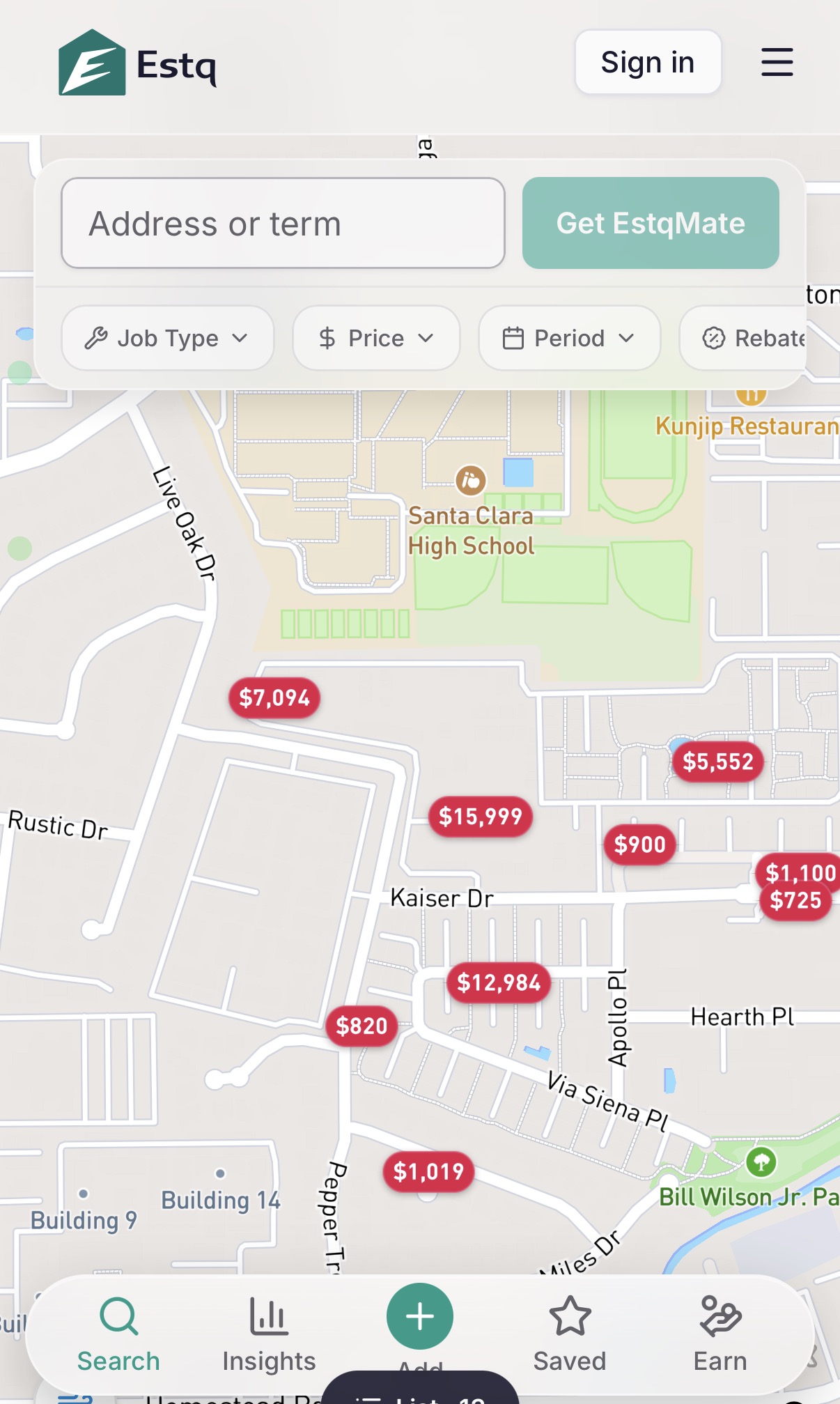
What projects have recently been completed nearby?
And now:
What is happening in the environment around this property?
The partnership with Sparrow brings us closer to that goal.
From City Averages to Building-Level Conditions
There is an enormous amount of information available about cities, ZIP codes and neighborhoods.
The next generation of property technology will make that information useful at a much smaller scale.
The address.
ESTQ brings together information about the building. Sparrow adds measured environmental information from the streets around it.
Together, we're building a more complete way to understand a property - inside and out. This is also the core positioning proposed for the joint ESTQ x Sparrow launch.
Environmental Intelligence powered by Sparrow - now available inside ESTQ.
About Sparrow Analytics
Sparrow Analytics develops hyperlocal environmental intelligence using mobile Sparrow Nodes deployed on vehicle fleets. Its technology measures pollutants and microclimate conditions along real streets, creating street-level environmental datasets that can complement traditional stationary monitoring. Sparrow's current documentation lists measurements including particulate matter, NO₂, O₃, CO and temperature.